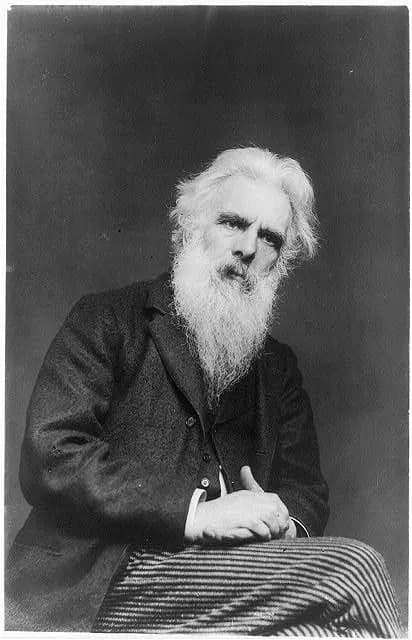
Born above a coal merchant's shop on Kingston High Street in 1830, Edward Muggeridge would transform into Eadweard Muybridge and change how humanity sees movement forever.
A Kingston Childhood
Edward James Muggeridge entered the world on 9 April 1830 at No. 30 High Street, Kingston upon Thames, living above the grain and coal business run by his father, John. The premises sat adjacent to the River Thames, placing the young Edward at the heart of a bustling market town. When his father died in 1843, his mother Susanna continued the trade. The family name would evolve several times over his lifetime: from Muggridge to Muygridge, then Muybridge, before finally adopting the Anglo-Saxon "Eadweard" that now appears on the British Film Institute plaque marking his final Kingston home.
The American Adventure
At age 20, Muggeridge departed for the United States, arriving in New York City in 1852. He worked as a bookseller there and in New Orleans before settling in San Francisco by the autumn of 1855. According to family lore, he declined his grandmother's offer of financial assistance with the declaration: "I'm going to make a name for myself. If I fail, you will never hear of me again." The gamble paid off, though not in the way anyone might have predicted.
Accident and Reinvention
A July 1860 stagecoach crash in Texas left Muggeridge with a serious head injury that, by some accounts, altered his personality. The accident forced him back to Kingston for recuperation between 1860 and 1867. During this period of convalescence, he discovered photography and secured two British patents. In February 1867, he returned to San Francisco equipped with this new technical knowledge and a changed outlook. The name "Muybridge" began appearing in his professional work from 1865 onwards.
The Horse That Changed Everything
On 15 June 1878, at the Palo Alto Stock Farm owned by former California governor Leland Stanford, Muybridge arranged a battery of 12 cameras along a racetrack. The resulting sequence, known as "The Horse in Motion," captured something the human eye had never before seen: a running horse with all four hooves off the ground simultaneously. The images settled a long-standing debate about equine locomotion and demonstrated photography's power to freeze moments invisible to ordinary perception.
Inventing Cinema
The following year, Muybridge invented the zoopraxiscope, a device that projected painted motion pictures from glass discs. This invention predated flexible perforated film and established the technical foundations upon which modern cinema would be built. Between 1883 and 1886, working at the University of Pennsylvania, he produced over 100,000 images of animals and humans in motion, published as "Animal Locomotion" in 1887. His work influenced artists, scientists, and eventually the entire motion picture industry.
The Name From Kingston's Stone
During a return visit to England in 1882, Muybridge delivered lectures at the Royal Institution in London. He also adopted the spelling "Eadweard," derived from the Anglo-Saxon inscription on the Coronation Stone in Kingston's market place. The stone, which had been re-erected in 1850 approximately 100 yards from his childhood home, commemorates the ancient kings crowned in Kingston. This deliberate rebranding connected the international pioneer to his Surrey roots in a gesture of local pride.
Final Years in Kingston
Muybridge retired permanently to Kingston in 1894, purchasing Park House at 2 Liverpool Road. He died there on 8 May 1904 from prostate cancer, at the home of his cousin Catherine Smith. His body was cremated, with the ashes interred at Woking Cemetery in Surrey. The gravestone misspells his name as "Eadweard Maybridge," an unfortunate typographical error that persists to this day.
The Kingston Museum Collection
In the same year as Muybridge's death, Kingston Museum opened its doors, funded by Andrew Carnegie. The Grade II listed building now houses the world's most significant Muybridge collection, bequeathed by the photographer himself. The archive comprises over 3,000 items, including more than 2,200 lantern slides and glass plates, the original zoopraxiscope, 70 glass discs from his lectures, and a rare mammoth-plate San Francisco panorama from 1878. The permanent Muybridge Gallery displays around 50 items arranged across six themes: Famous Lecturer, Muybridge in Kingston, Flying Horse, Animal Locomotion, Magnificent Views, and The Magic of Moving Images.
Legacy
The British Film Institute commemorates Muybridge's final residence with a plaque at Park House. His work established the principles of motion photography that would eventually lead to Hollywood, television, and digital video. From a childhood above a High Street shop to the invention of cinema itself, Muybridge's journey began and ended in Kingston, leaving the town with a cultural legacy that continues to draw researchers and enthusiasts from around the world.