Kingston's Oldest Surviving Structure Has Witnessed Centuries of Dramatic History
Clattern Bridge, spanning the Hogsmill River in Kingston upon Thames, stands as one of England's oldest intact bridges. Built around 1175 during the Norman era, this stone structure replaced an earlier Saxon crossing known as "Clatrung Bridge" and remains a vital part of Kingston's High Street to this day.
Norman Engineering Still Bearing Modern Traffic
The bridge's lower portion consists of three stone arches constructed from dressed ashlar stones with flint rubble filling, a testament to Norman masonry techniques. Despite being nearly 850 years old, the bridge continues to carry a full load of modern vehicle traffic. The structure has been widened twice: first in 1758 with red brick additions bonded to the original stone arches, and again in 1852 when ornamental iron railings were installed.
The bridge was designated a scheduled ancient monument on 16 February 1938 and holds Grade I listed status, recognising its national heritage importance.
The Echo of Hooves: A Name Preserved in Sound
The bridge's unusual name derives from the "clattering of horses' hooves" as they crossed its surface. First recorded in 1293 as "Clateryngbrugge," the name has evolved through variations including "Clayton Bridge" on John Roque's 1761 map. This onomatopoeic naming offers a rare acoustic connection to medieval travel.
The Ducking of Scolds: Kingston's Public Punishments
For centuries, Clattern Bridge served as the site for the public punishment of scolds, women deemed disorderly or argumentative. Using a ducking stool (also called a cucking stool), offenders were strapped into a chair and plunged into the river below, often before large crowds.
The punishment employed a ducking stool, a chair mounted on a long lever that could be lowered into the water, rather than a scold's bridle (an iron muzzle). The term "cucking-stool" dates to around 1215, derived from the verb "cukken" meaning to defecate, not from "cuckold" as sometimes assumed.
Kingston continued this practice remarkably late. In 1745, the landlady of the Queen's Head public house was ducked at the bridge before a substantial crowd, marking one of the final recorded instances of this medieval punishment in the town.
Shrove Tuesday Football: Kingston's Rowdy Tradition
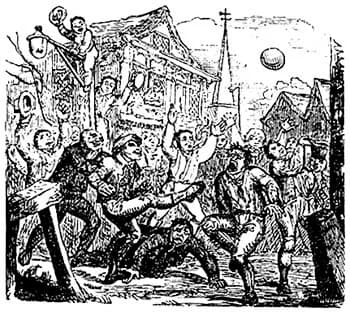
Clattern Bridge played a central role in another local custom: the annual Shrove Tuesday football match. From medieval times until 1866, the bridge served as one goal, with Kingston Bridge over the Thames forming the other. The game pitted two teams, Townsend and Thames Street, against each other across the entire town.
According to historian William Biden's 1852 account, the tradition originated from an eighth-century dispute between rivals Kenulf and Kynard. The match began at the Druid's Head public house on Shrove Tuesday and continued throughout the town.
The game was notoriously chaotic and disruptive. In 1798, authorities read the Riot Act to suppress it, summoning cavalry from Hampton Court. The troops never arrived; they were reportedly occupied playing football themselves.
Urban development eventually rendered the street football impossible. The Highway Act 1835 banned football on public roads, and Kingston's match was specifically outlawed in 1867. The last recorded game took place in 1866.
A Link to Modern Conservation
The bridge remains relevant today through an unexpected modern initiative. In 2012, conservationists installed special tiles on the river bed beneath the archways to assist European eels in their upstream migration, connecting this medieval structure to contemporary environmental efforts.
What Remains Visible
Visitors walking across Clattern Bridge today pass over nearly nine centuries of Kingston history. The original Norman stonework remains visible in the lower arches, while the 1758 and 1852 additions speak to the bridge's continuing evolution. From Saxon origins through Norman construction, medieval punishments, raucous football matches, and modern traffic, Clattern Bridge embodies Kingston's layered heritage.
The bridge stands as a reminder that Kingston's most unassuming structures often harbour the most extraordinary stories.